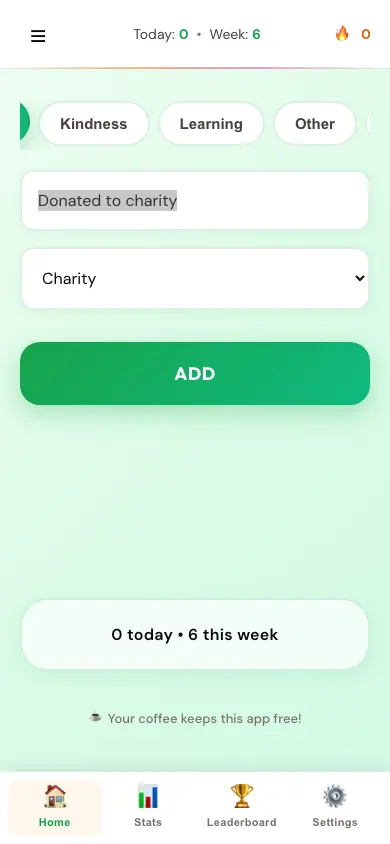
Good Deeds Tracker LIVE
Track your daily acts of kindness with zero friction. No account, no signup, no internet required. Your data stays on your device.
Track kindness. Build habits. Improve your health.
Kindness isn't a moral choice. It's a biological hack. Good Deeds Tracker helps you harness the "Helper's High." That's the dopamine spike you get from being decent to others.
Why It Works
Your brain is wired for social connection. When you help someone, your body rewards you.
- The Helper's High: Altruism triggers rewards in your brain. It feels good because it is good for you.
- Lower Stress: Being kind lowers cortisol. It's cheaper than therapy. Faster than meditation.
- Better Health: Studies link volunteering to lower inflammation and better heart health.
- The 66-Day Challenge: Research shows it takes 66 days to form a habit. We help you count them.
Features That Actually Matter
We stripped out the bloat. No ads. No "social" feed. Just the tools you need.
- Zero Setup: You're tracking in 5 seconds.
- Visual Streaks: Watch your chain grow. Don't break it. (It works.)
- Custom Categories: Track what matters to you. Helping neighbors? Donating? Calling your mom?
- Export Anytime: It's your data. Download it as JSON whenever you want.
- Offline-First: Works without internet. Syncs when you're back online.
Privacy Promise
We don't want your data.
- Local-First: Your data lives on your device.
- No Tracking: We don't run analytics. We don't know who you are.
- Data Portability: Export your full history anytime.
- Optional Sync: Streak counts can be shared anonymously if you opt-in.
FAQ
Is it really free? Yes. Donations keep the lights on, but they aren't required.
Will you sell my data? No. We can't sell what we don't have.
What if I lose my phone? Your data lives on your device. If you lose it, it's gone. (Unless you exported a backup.)
Start Your Streak
Small acts. Compound interest. Start today.
Scientific Sources
- Habit Formation Timeline: Lally, P., et al. (2010). "How are habits formed." European Journal of Social Psychology.
- Mortality Risk: Okun, M. A., et al. (2013). "Volunteering by older adults." Psychology and Aging.
- The "Helper's High": Moll, J., et al. (2006). "Human fronto-mesolimbic networks guide decisions about charitable donation." PNAS.
- Pay-It-Forward Effect: Rhoads, S. A., & Marsh, A. A. (2023). "Doing Good and Feeling Good." World Happiness Report.
- Motives & Health: Konrath, S., et al. (2012). "Motives for volunteering are associated with mortality risk in older adults." Health Psychology.